

- Laws & Regulation
- 16 Minute Read
Sublet agreement in BC: Rules, responsibilities and what to include
Updated on Nov 11, 2026
Written By:
Verified By:

A sublease agreement is a written contract between a tenant and the person who’ll live in their rental unit while they’re away. In British Columbia, subletting means you move out for a set period, let someone else (a subtenant) live there and plan to move back in. Your original tenancy agreement with your landlord stays in place the whole time, while the sublease sets out the arrangement between you and your subtenant: how long they’ll stay, how much they’ll pay you and when you’ll return.
Subletting is legal in BC, but you need your landlord’s written consent first, or an order from the Residential Tenancy Branch (RTB) allowing it. BC’s Residential Tenancy Act also limits when a landlord can say no, stops landlords from charging a fee to approve a sublet and keeps the original tenant responsible to the landlord throughout. Here’s how those rules work for tenants and landlords, and what a BC sublet agreement should include.
Subletting your unit? Screen your potential subtenant with SingleKey before you sign anything. Start screening →
Sublease vs. lease assignment: What’s the difference?
The main difference between subletting and assigning a lease is whether you plan to move back in. With a sublet, you leave temporarily and remain responsible to your landlord. With a lease assignment, you move out permanently and a new tenant takes over your lease.
| Comparison | Sublet | Lease assignment |
|---|---|---|
| How long it lasts | Temporary, with a set end date before your lease term or rental period ends | Permanent, with the new tenant taking over the rest of your tenancy |
| Do you plan to return? | Yes, you keep the right to move back in when the sublet ends | No, you give up the right to move back in |
| What happens to your lease? | Your lease stays in place. The subtenant rents from you under a separate agreement | Your lease transfers to the new tenant on the same terms |
| Who the new person pays | You, and you continue paying your landlord | The landlord directly |
| Who’s responsible for rent and damage? | You remain responsible to your landlord for rent and damage caused by the subtenant | The new tenant takes over your lease obligations. You could still be responsible if the assignment agreement doesn’t clearly transfer them |
| Best for | Keeping your rental while you’re away for work, school or travel | Moving out for good because you’re relocating, buying a home or no longer need the rental |
Before setting your sublet dates, check when your lease term ends. In BC, a fixed-term sublet must end before your own lease term does, even if it’s just one day earlier. This preserves your right to return. If you hand over the rental for the full remaining term, the RTB may treat it as an assignment, even if your agreement calls it a sublet. See the RTB’s Policy Guideline 19.
The rest of this guide explains how subletting works in BC.
What tenants need to know before subletting in British Columbia
Once you know a sublet fits your plans, there are three things to sort out before anyone moves in: getting your landlord’s permission, choosing the right person and understanding what you’ll still be responsible for while you’re away.
Step 1: Get your landlord’s written consent
Under section 34 of the Residential Tenancy Act, you can’t sublet without your landlord’s written consent. Send your request in writing before the subtenant moves in, and include the proposed subtenant’s name and contact information and the exact dates of the sublet. Ask for your landlord’s answer in writing too, and keep copies of both. A quick “that’s fine” in the hallway won’t help you much if there’s a disagreement later.
How much say your landlord has depends on your tenancy. If you have a fixed-term tenancy with six months or more left, your landlord can’t unreasonably refuse. With less than six months left on a fixed term, your landlord has more discretion, and the Act doesn’t directly address month-to-month tenancies. Either way, if you believe your landlord is refusing unreasonably, you can apply to the RTB for dispute resolution and ask for an order allowing the sublet.
Step 2: Find and screen a potential subtenant
Your landlord may review the person you propose, but you’re the one relying on them to pay you and look after your home while you’re gone. Before you commit, it’s worth checking the same kinds of information a landlord would.
| What to check | What it tells you | How to check it |
|---|---|---|
| Identity | That the person is who they say they are | Government-issued photo ID that matches their application |
| Employment and income | Whether the rent is realistic for them | Recent pay stubs, an employment letter or a call to their employer (how to verify employment) |
| Rental history and references | How they’ve handled past tenancies | Contact details for previous landlords and a few reference check questions |
| Credit information | How they’ve managed bills and debt | A credit report, run only with their written consent |
A screening service such as SingleKey can bring much of this together in one report, with the applicant’s consent, so you can look at their credit, income and rental history side by side before agreeing to anything. If you haven’t reviewed one before, this guide on how to read a tenant credit report explains what each section means.
Step 3: Know what you’re still responsible for
Signing a sublease doesn’t change your agreement with your landlord. You’re still the tenant, and your landlord will keep looking to you for the rent and everything else your tenancy agreement requires.
Caution: You’re still responsible for the rent. Signing a sublease agreement doesn’t remove your responsibility to your landlord. If your subtenant stops paying rent, you’re still responsible for making sure your landlord is paid.
Say your rent is $2,300 a month and you sublet for six months while working in Calgary. If your subtenant stops paying in month four, your landlord still expects $2,300 from you each month, and missing those payments could put your own tenancy at risk. You’d be covering $6,900 for the last three months yourself, then trying to recover it from your subtenant separately, generally through the RTB’s dispute resolution process.
The same goes for damage and other problems. Your landlord has no contract with your subtenant, so if they damage the unit, break building rules or disturb the neighbours, your landlord deals with you. A serious breach could even lead your landlord to end your tenancy, and if that happens, the sublet ends with it.
That’s why choosing your subtenant carefully matters as much as getting consent. Someone who can comfortably afford the rent and has a solid rental track record makes these situations much less likely.
Before you hand over your keys, know who you’re subletting to.
Screen your potential subtenant before signing the agreement. SingleKey can help you review credit, income, background and rental history information before you make a decision.
What landlords should know about subletting in British Columbia
If your tenant asks to sublet, both your decision and the way you record it matter. Give your answer in writing, and if you agree, name the subtenant and the sublet dates so there’s no confusion later about what you approved.
During the sublet, your tenancy is still with your original tenant. You don’t have a contract with the subtenant, so rent, repair requests and any problems with the unit continue to go through your tenant. Only you, as the landlord, have the right to make repairs, so a subtenant who needs something fixed asks your tenant, who then asks you.
If a tenant sublets without your written consent, you may have grounds to serve a One Month Notice to End Tenancy for Cause (form RTB-33) under section 47(1)(i) of the Act. Whether that notice holds up if your tenant disputes it depends on whether an arbitrator finds that a real sublet took place. A tenant who stays in the unit and rents out a room, for example, generally hasn’t sublet under the Act, although that could still break other terms of your agreement. If you do end up ending the tenancy, our guide to BC eviction notices explains the process.
Can a landlord refuse a proposed subtenant?
Yes, in some cases. You’re entitled to review the proposed subtenant before deciding, including asking for credit and reference checks. If you reasonably believe the person won’t be able to meet the terms of the tenancy agreement, you can refuse.
What you can’t do is refuse unreasonably when a fixed-term tenancy has six months or more left. If your tenant thinks your refusal crosses that line, they can apply to the RTB, and an arbitrator will look at the specific circumstances. An unreasonable refusal can also cost you later. If your tenant ends up leaving early, the RTB may find you didn’t do enough to limit your rental losses, which can reduce what you’re able to claim. As with any tenant selection decision, your reasons also need to respect human rights rules.
Can a landlord charge a fee for approving a sublet in BC?
No. Under section 34(3) of the Residential Tenancy Act, a landlord can’t charge a tenant anything for considering, investigating or consenting to a sublet or assignment. That covers approval or processing fees, and it also means a landlord who wants to check out your proposed subtenant can’t pass that cost on to you.
If your landlord asks for a fee to approve your request, you can point them to section 34(3) or contact the RTB for help.
Other questions about subletting in BC
Can you charge a subtenant more than your rent?
The Residential Tenancy Act doesn’t directly say how much a tenant can charge a subtenant. However, BC’s guidance says your sublease must line up with your original tenancy agreement, and charging more than you pay can lead to disputes with both your landlord and your subtenant. The simplest approach is to charge the same rent you pay. If you’re thinking about charging more, check with the RTB before you sign.
What if your subtenant won’t move out when the sublet ends?
Once your subtenant moves in, you become their landlord under the Act, so you can’t simply change the locks or remove their belongings. You’d generally need to go through the RTB’s dispute resolution process. A clear end date and move-out terms in your sublease make your position much easier to prove if it comes to that.
What should be included in a British Columbia sublease agreement?
The RTB doesn’t publish a dedicated sublease form for apartments, suites or houses. Its sublet consent form, RTB-25, is only for manufactured home sites. So whether you start from a template or write your own BC sublet agreement, what matters is what it covers.
Your sublease also needs to line up with your original tenancy agreement, because your subtenant takes on the same rights and obligations that agreement sets out. Keep a copy of it beside you as you work through this checklist, and if you need a refresher on its standard terms, see our guide to BC tenancy agreements.
A BC sublease agreement should include:
- Names and contact details: Full legal names and contact information for you and your subtenant.
- Rental property information: The rental unit’s address, plus any part of the property that isn’t included, such as a storage locker or parking stall you’re keeping.
- Original tenancy agreement: A reference to your existing agreement, ideally with a copy attached.
- Sublet start and end dates: The exact move-in date and an end date set before your own tenancy ends, so you can move back in.
- Rent and payment terms: The rent amount, the day it’s due each month, how it will be paid (such as e-transfer) and who receives it, usually you.
- Utilities: Which utilities are included and who pays for the rest.
- Property-use rules: Building or strata bylaws and any pet, smoking or guest terms from your original agreement.
- Maintenance and repairs: Who handles day-to-day upkeep and how the subtenant should report repairs.
- Damage: How damage will be handled and paid for.
- Unpaid rent or other breaches: What happens if rent is late or another term is broken.
- Move-out arrangements: When the subtenant must move out and return keys, fobs and parking passes.
- Signatures and dates: Signatures from you and your subtenant, with the date each person signed.
The end date deserves extra care. If your fixed-term tenancy ends on August 31, 2027, a sublet from January 1 to June 30, 2027 leaves room for you to move back in before the term is up. A sublet running right to August 31 could be treated as an assignment instead. If you’re on a month-to-month tenancy, set a specific end date and state clearly that you’ll be moving back in.
Screen a potential subtenant with SingleKey
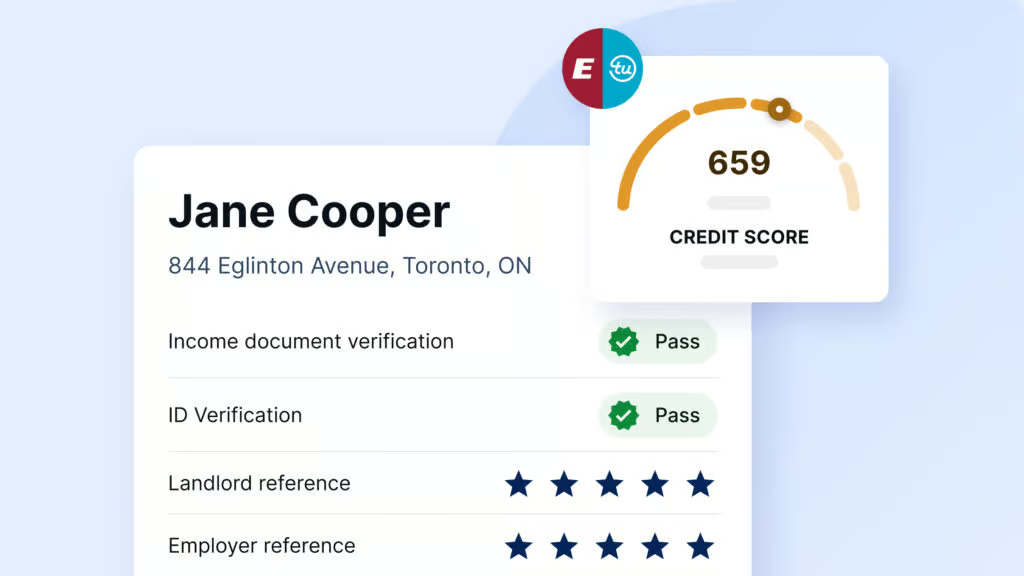
Before you sign a sublease agreement, a SingleKey Tenant Screening Report gives you a clearer picture of the person you’re trusting with your home. You invite your potential subtenant to complete an online application, and once they consent, you can review their credit history from Equifax, TransUnion or both, along with their employment and income details, references, rental history, eviction and public records, and identity verification.
Reports can be ready in as little as five minutes, and there’s no subscription. Screening can’t guarantee someone will pay on time, but it means your decision rests on more than a good first impression.
Ready to choose your subtenant?
Order a Tenant Screening Report and review your applicant’s results before you both sign the sublease.
