

- Laws & Regulation
- 22 Minute Read
How to End a Tenancy in BC: A Landlord’s Guide to Eviction Notices
Updated on Oct 6, 2026
Written By:
Verified By:
If you need to evict a tenant in British Columbia, the first thing to figure out is why you're ending the tenancy. You can't end a tenancy just because you want the unit back, and there isn't one BC eviction notice that works for every situation. Your reason determines which notice or application you need, how much notice the tenant gets and what happens next.
From there, a lot depends on the tenant. They may move out after receiving the notice, fix the problem that led to it or dispute the eviction. And if they still won't leave after you get an Order of Possession, there's one more legal step before you can get the unit back.
This guide explains when you can legally end a tenancy in BC, which notice or application you need and what happens at each stage until you regain possession of your rental.
Already covered by Rent Guarantee? Raise a demand through your SingleKey account as soon as a payment is missed or a serious tenancy issue occurs.
When can you evict a tenant in BC?
Before you give your tenant any kind of notice, make sure you have a legal reason to end the tenancy. In BC, wanting the tenant to leave isn't enough on its own. The reason has to fall within one of the circumstances where the Residential Tenancy Act (RTA) allows a landlord to end a tenancy.
Sometimes that reason is tied to something the tenant has done. They may have stopped paying rent, repeatedly paid late, seriously damaged the property or created an ongoing problem for other people in the building. In other cases, the tenancy can end even when the tenant hasn't done anything wrong. You may be planning to move into the unit yourself, for example, or you may be demolishing or converting the property.
That distinction matters because your reason doesn't just determine whether you can evict the tenant. It determines how you have to do it. A landlord dealing with unpaid rent follows a very different process from one who wants to move into the unit, even though both situations can legally end the tenancy.
Here are the most common grounds for evicting a tenant in BC:
- Unpaid rent or utilities. The tenant hasn't paid their rent or the utilities they're responsible for under the tenancy agreement.
- Persistent late rent payments. Repeated late payments, generally at least three within 12 months, can be grounds for eviction even if the tenant eventually pays.
- Disturbances and safety concerns. The tenant or someone they've let into the unit significantly disturbs the landlord or other tenants, or puts their health or safety at risk.
- Failure to repair property damage. The tenant doesn't repair damage to the rental as required under section 32 of the RTA.
- Overcrowding. There's an unreasonable number of occupants living in the rental unit.
- Illegal act or business. The tenant or another occupant is engaged in illegal activity that has damaged or could damage the property or put the health and safety of others at risk.
- Violation of lease terms. The tenant has broken a material term of the tenancy agreement, such as subletting the rental without the landlord's written consent.
- Personal use by landlord. The landlord or a close family member will move into the rental unit.
- Personal use by purchaser. The property has been sold and the purchaser will move into the rental.
- Demolition. The landlord intends to demolish the rental property.
- Major renovations. The landlord intends to complete extensive repairs or renovations that require the rental to be vacant.
- Conversions. The landlord intends to convert the property to another use, such as a commercial business or cooperative housing unit.
- Tenant no longer qualifies for a subsidized rental unit. Under section 49.1 of the RTA, a landlord can end the tenancy of a tenant who lives in a subsidized rental and no longer qualifies for the unit.
Some of these reasons come with additional requirements, particularly when the tenant hasn't done anything wrong. Landlord use is a good example. If you're ending the tenancy because you or a close family member will move in, you must pay the tenant compensation equal to one month's rent, and the unit must be used for that purpose for at least 12 months. Those rules exist so a landlord can't claim they need the unit for a family member simply as a way to remove a tenant.
If you don't follow through on the reason you gave, the tenant can claim compensation through the Residential Tenancy Branch (RTB). Demolitions, conversions and major renovations have their own requirements too, set out in Part 4 of the RTA, so confirm the rules for your situation before you start.
Which BC eviction notice should you use?
There isn't one general eviction notice that every BC landlord uses. The Residential Tenancy Branch's eviction notices are officially called Notices to End Tenancy, and each reason for ending a tenancy has its own form and notice period. Some reasons require a completely different procedure.
Major renovations are the clearest example. If the unit needs to be empty for renovations, you can't serve a notice and wait out the notice period. You have to apply to the RTB for an order ending the tenancy.
The table below shows where to start based on why you're ending the tenancy.
| Reason | Notice form/process | Minimum notice |
|---|---|---|
| Unpaid rent/utilities | RTB-30 (10 Day Notice to End Tenancy). For utilities, a 30-day written demand must be served to the tenant first. | 10 days |
| Persistent late rent payments | RTB-33 (One Month Notice to End Tenancy) | 1 month |
| Disturbances and safety concerns | RTB-33 (One Month Notice to End Tenancy) | 1 month. Urgent and serious cases can apply to the RTB to end the tenancy early without a formal notice. |
| Failure to repair property damage | RTB-33 (One Month Notice to End Tenancy) | 1 month |
| Overcrowding | RTB-33 (One Month Notice to End Tenancy) | 1 month |
| Illegal act or business | RTB-33 (One Month Notice to End Tenancy) | 1 month. Urgent and serious cases can apply to the RTB to end the tenancy early without a formal notice. |
| Violation of lease terms | RTB-33 (One Month Notice to End Tenancy) | 1 month |
| Personal use by landlord | RTB-32L (Three Month Notice to End Tenancy). Must be generated through the RTB web portal. | 3 months |
| Personal use by purchaser | RTB-32P (Three Month Notice to End Tenancy) | 3 months |
| Demolition | RTB-29 (Four Month Notice to End Tenancy) | 4 months |
| Major renovations | Apply to the RTB for an order under section 49.2 | No standard eviction notice. RTB approval is required. |
| Conversions | RTB-29 (Four Month Notice to End Tenancy) | 4 months |
| Qualifying end of employment | RTB-33 (One Month Notice to End Tenancy) | 1 month |
| No longer qualifies for subsidized rental unit | RTB-32Q (Two Month Notice to End Tenancy) | 2 months |
Once you've identified the right form, check the notice period and service requirements too. A valid reason won't rescue an invalid notice. Using the wrong form, calculating the date incorrectly or serving the tenant improperly can delay the eviction and may mean repeating part of the process.
How to evict a tenant in BC: step by step
An eviction in BC is a process set out in the RTA and overseen by the RTB, and it can stop or continue at several points depending on how the tenant responds. The simplest outcome is that the tenant moves out by the date on the notice, and the process ends there. If they fix the problem, dispute the notice or stay after they're legally required to leave, the process continues through the steps below.
Step 1: Serve the correct notice or apply to the RTB
For most evictions, the first step is serving the Notice to End Tenancy that matches your reason for ending the tenancy. You can serve it in person, by mail or by attaching it to the door of the rental unit. You can only email it if the tenant has agreed in writing to receive documents by email. How you serve the notice matters, because the tenant's deadlines run from when it's considered received.
Not every eviction starts with a notice. For major renovations, you apply to the RTB for an order instead. And in urgent cases involving an immediate and serious risk, such as a tenant assaulting you or another tenant, you can apply directly to the RTB to end the tenancy early without waiting through a notice period.
Step 2: See how the tenant responds
Once the notice is served, the tenant may move out, fix the problem or dispute the notice. How long they have to dispute it depends on the type of notice and ranges from 5 to 30 days.
Unpaid rent shows how this works. If you serve a 10 Day Notice to End Tenancy because the tenant hasn't paid rent, they have five days after receiving it to pay what they owe or dispute the notice. If they pay in full within that time, the notice is cancelled and the tenancy continues, even though the rent was late and you've already served the form.
Until the tenancy has legally ended, don't try to speed things up yourself. Changing the locks, shutting off utilities or otherwise pressuring the tenant to leave can turn a lawful eviction into an illegal one.
Step 3: What happens if the tenant doesn't agree with the eviction notice?
If the tenant disputes the notice, the RTB decides whether the tenancy should end. You'll need to show what happened, why it gave you legal grounds to end the tenancy and that you followed the required process. The tenant gets to present their side too.
The evidence you need depends on your reason. Payment records and the tenancy agreement can support an unpaid rent case, while photos, inspection reports, complaints or correspondence with the tenant can support a case involving damage or disturbances.
You can apply online or on paper. To apply online, you'll need a basic BCeID account.
Some cases qualify for the RTB's direct request process, where an adjudicator decides based on your written application and evidence, with no hearing. Filing a direct request costs $100, and you must serve the proceeding package on your tenant within 3 days of it becoming available. Other cases go to a hearing. Either way, if the RTB agrees that the tenancy should end, you'll receive an Order of Possession.
Step 4: Get an Order of Possession
An Order of Possession gives you the legal right to get your rental back and sets the date the tenant has to leave. If they leave by that date, the process ends there.
The order doesn't let you remove the tenant yourself, though. If they're still in the unit, you can't change the locks, put their belongings outside or physically force them to leave. These self-help evictions are illegal in BC, and the RTB's Compliance and Enforcement Unit can fine landlords up to $5,000 for them. To get the tenant out, the order has to be enforced through the court.
Step 5: What happens if the tenant doesn't leave?
If the tenant stays after the date on the Order of Possession, you'll need to file it with the BC Supreme Court and get a Writ of Possession. The writ is what allows a court bailiff to carry out the eviction.
Choose a bailiff and contact them before you file to confirm their availability, fees and what they'll need from you. Your court application includes:
- Form 17.2 (Requisition)
- Affidavit of Service
- Form 72 (Writ of Possession)
Once the writ is issued, the bailiff can enforce the eviction and, if necessary, remove the tenant and their belongings. After possession has legally been returned to you, you can change the locks and secure the property.
Already covered by Rent Guarantee? Raise a demand through your SingleKey account as soon as a payment is missed or a serious tenancy issue occurs. SingleKey can work with your tenant to resolve the issue and, if an eviction is needed, help with notices, filing, the hearing and enforcement process, including up to $2,000 in eligible eviction-related legal fees.
How long does it take to evict a tenant in BC?
There's no single eviction timeline in BC. Two landlords can start an eviction for similar reasons and get their units back at very different times, because one tenant moves out after receiving notice while the other disputes it or refuses to leave.
The notice period is the starting point. Depending on your reason, it ranges from 10 days to four months. But it only tells you when the tenancy can end if everything goes as planned, not when you'll physically have the unit back. The timeline gets longer with each stage your case goes through:
- Disputes. Tenants have 5 to 30 days to dispute a notice, depending on the type. If they do, it can take several weeks to get a hearing or have your case reviewed, and the RTB generally has 30 days to decide after a standard hearing.
- Enforcement. If the tenant stays after you get an Order of Possession, you'll need time to get a Writ of Possession and book a bailiff. The tenant can also ask the RTB to review the decision, which can delay things further.
- Paperwork. A mistake with the form, termination date, service or your RTB application can delay the case and may mean repeating part of the process. Using the right BC rental documents from the start helps avoid that.
- Urgent cases. Situations involving an immediate and serious risk may qualify for an expedited hearing, which moves faster than the standard process.
So when you're estimating when you'll have your rental back, look past the date on the notice and plan for the stages that could follow.
BC eviction notice FAQs
Can a landlord end a month-to-month tenancy in BC?
Only for one of the reasons allowed under the RTA. A month-to-month tenancy doesn't give you the right to end it without a reason. You still need valid grounds and the matching Notice to End Tenancy, such as a One Month Notice for cause or a Three Month Notice if you or a close family member will move in.
What is a 10 Day Notice to End Tenancy in BC?
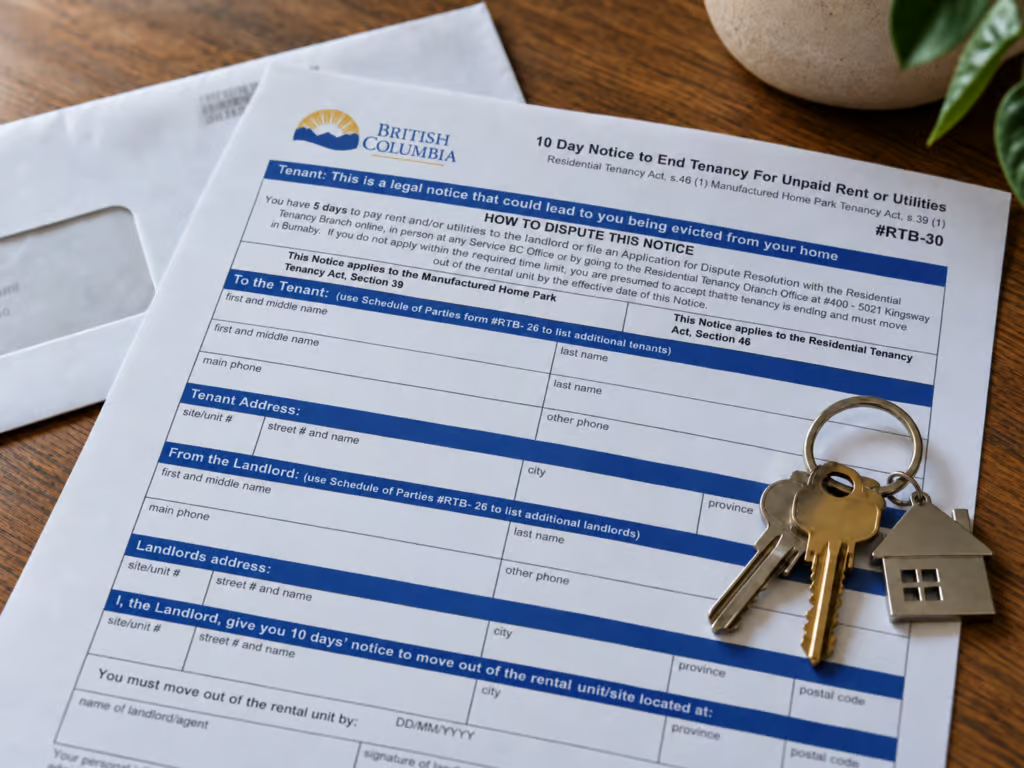
It's the RTB-30 form a landlord uses when a tenant hasn't paid rent or utilities. The tenant has five days after receiving it to pay in full or dispute the notice. If they pay, the notice is cancelled. If they do neither, the tenancy ends on the date on the notice. For unpaid utilities, you first have to give the tenant a written demand and wait 30 days before serving the notice.
Where can I get a BC eviction notice form?
Notice to End Tenancy forms are available from the Residential Tenancy Branch. The Three Month Notice for landlord's use (RTB-32L) is the exception: since June 18, 2025, it has to be generated through the RTB's web portal.
Can you evict a tenant in the winter in BC?
Yes. BC has no rule against evictions during the winter. As long as you have a valid reason and follow the correct process, an eviction can happen at any time of year.
Protect your next tenancy from the start
You can't screen your way out of every possible eviction. A tenant's circumstances can change after they move in, and even someone who looked reliable at the start can lose income or stop paying rent.
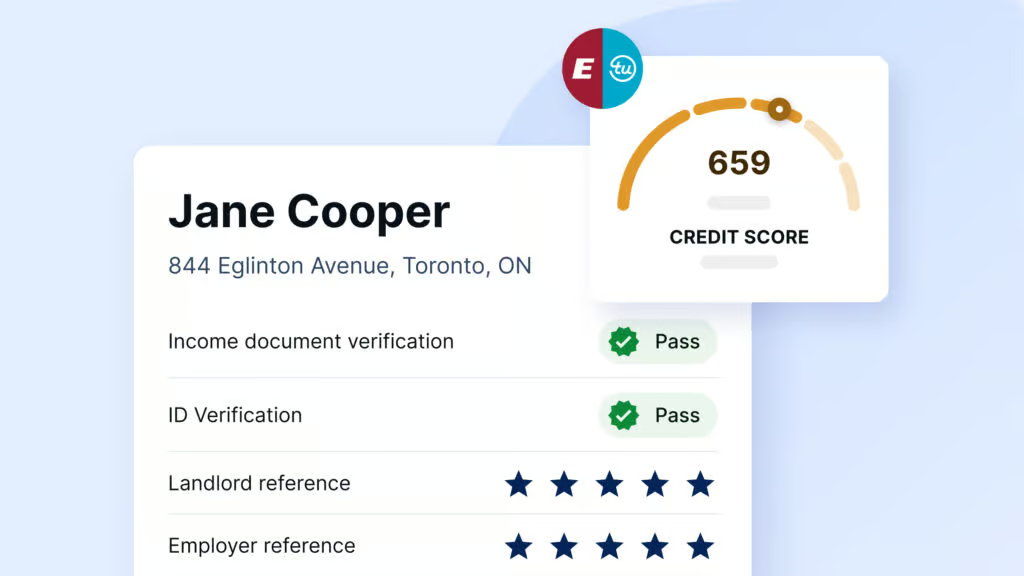
You can still reduce your risk before the next tenancy begins. SingleKey's Tenant Screening report brings together an applicant's credit history, income sources, identity, employment, landlord references and available eviction history, so you have more context than the rental application alone gives you.
Screening can't protect you from something that changes later, though. For eligible tenancies, SingleKey's Rent Guarantee covers up to 12 months of missed rent, along with property damage protection and legal or eviction support. It can even support you throughout the eviction process.
Important note: Rent Guarantee needs to be in place before the problem begins. If your current tenant has already stopped paying rent or another tenancy issue is underway, you can't purchase coverage now and use it for that existing problem.
Protect your next tenancy with Rent Guarantee
Get coverage for up to 12 months of missed rent, property damage and legal or eviction support on eligible tenancies.
Explore Rent Guarantee