

- Laws & Regulation
- 20 Minute Read
BC Tenancy Agreement: A Landlord’s Guide
Updated on Sep 23, 2026
Written By:
Verified By:
If you're renting out a property in British Columbia, you need a written tenancy agreement that clearly sets out what you and your tenant are agreeing to. That means getting the basics down in writing, from the rent and tenancy dates to what's included with the rental and any rules that apply to the property.
You have some flexibility in what that agreement looks like, but BC sets rules for what it needs to contain and which terms you can and can't change. Your lease needs to fit your rental while still complying with the Residential Tenancy Act (RTA) and Residential Tenancy Regulation.
In this guide, we use "lease" and "tenancy agreement" interchangeably to mean the written agreement between you and your tenant. We'll explain how BC landlords can create a residential tenancy agreement, what needs to go in it, how fixed-term and month-to-month tenancies work, and what to do once the agreement is signed.
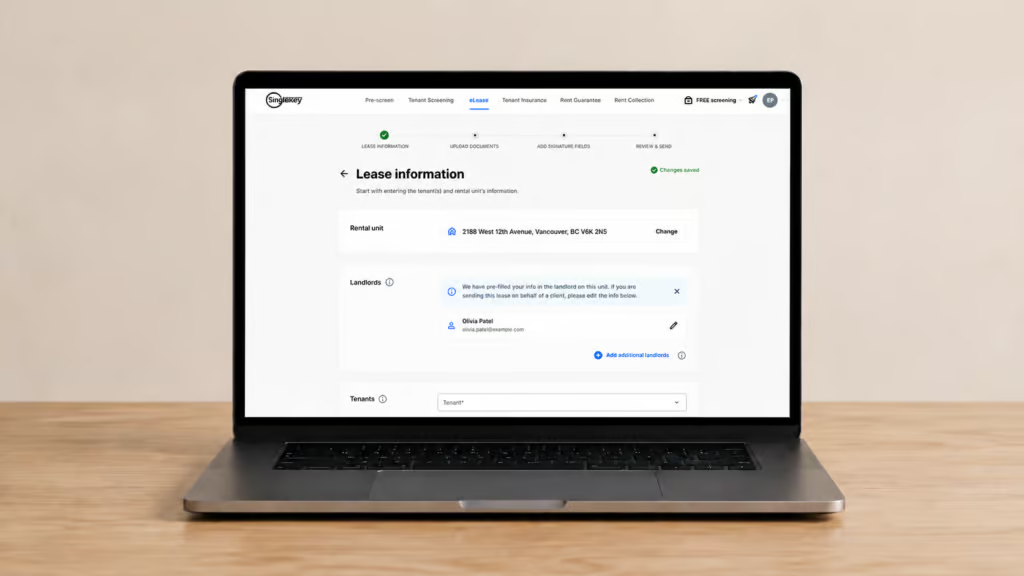
Ready to create your lease? SingleKey eLease is a free online lease builder for BC landlords. Get started →
Start with tenant screening
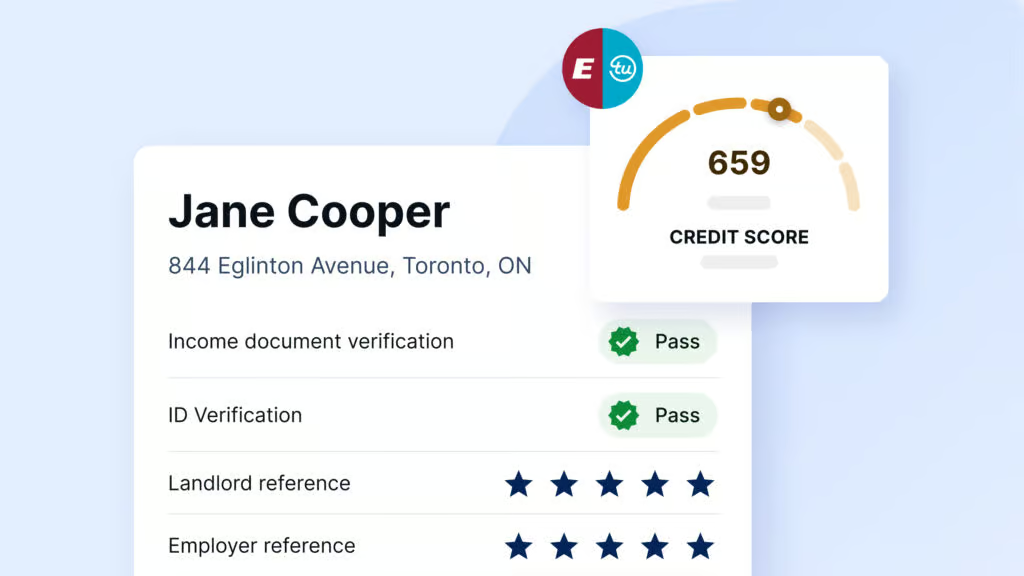
Before approving a rental applicant, verify the information provided in their rental application. A thorough screening process should consider the applicant's:
- Identity: Confirm that the applicant is who they say they are.
- Income and employment: Verify the income and employment information provided in the application.
- Rental history: Speak with previous landlords where appropriate to learn about the applicant's past tenancies.
- Credit history: Review how the applicant has handled credit and other financial obligations.
Looking at this information together can help you assess whether the applicant is likely to pay the rent and meet their responsibilities as a tenant.
You can run these checks yourself or use a tenant screening service. SingleKey's Tenant Screening brings credit, income, identity and other screening information into one report, so you can review the applicant before you commit to the tenancy.
Know the BC rules that apply to your lease
Most residential tenancies in BC are governed by the Residential Tenancy Act and Residential Tenancy Regulation. You can add terms that reflect your property and tenancy, but those terms must comply with BC tenancy law.
For example:
- You can specify which parking space belongs to the unit, whether smoking is allowed or which utilities are included in the rent.
- You can't use an additional clause to take away a right or responsibility established by BC tenancy law.
If a term conflicts with the RTA, regulations or BC's standard terms, the conflicting term may be unenforceable.
Your lease needs to be in writing
As a BC landlord, you need to prepare the tenancy agreement in writing. The agreement must:
- be signed and dated by both you and the tenant
- use type that's at least eight points in size
- be written clearly enough for a reasonable person to understand
The written agreement is also your record of what you agreed to. If you and the tenant remember a conversation about parking or utilities differently six months from now, you can check the lease instead of relying on memory.
You have options for creating your lease
BC provides the Residential Tenancy Agreement (Form RTB-1), but you don't have to use that particular form.
You can also use a BC lease template or prepare your own agreement. RTB-1 already includes BC's standard terms. If you use another agreement, you'll need to confirm it contains the required information and standard terms.
Choose between fixed-term or month-to-month
When you create the lease, you'll need to choose how the tenancy starts:
- Fixed-term tenancy: You and the tenant agree to an initial period, such as one year.
- Month-to-month tenancy: There's no initial end date. The tenancy continues each month until it's lawfully ended.
In BC, a fixed-term lease doesn't normally mean the tenant has to move out when the fixed term ends.
Fixed-term: commitment from both sides
Suppose you sign a one-year lease from September 1, 2026 to August 31, 2027. You and the tenant are committing to that initial one-year term, and a tenant who ends it early without a legal reason or an agreement with you may be responsible for losses you incur as a result.
But August 31 isn't normally a move-out date. If the tenant stays and you don't enter into another agreement, the tenancy generally becomes month-to-month.
The fixed term secures the initial commitment. It doesn't guarantee you'll get the property back at the end of the year.
Month-to-month: flexibility with no end date
If you and the tenant aren't entering into an initial fixed term, the tenancy can begin on a month-to-month basis instead. There's no predetermined end date, and the tenancy continues each month until you or the tenant ends it according to BC's rules.
Can you require the tenant to leave when the term ends?
You can still put an end date for the fixed term in the agreement. However, the fixed-term end date can only operate as a required move-out date in circumstances permitted under BC law.
For example, if your fixed term runs from September 1, 2026 to August 31, 2027, you would record August 31 as the end of the fixed term. Unless a permitted exception applies, however, you wouldn't add a requirement that the tenant vacate on August 31. The tenancy would normally continue month-to-month after that date.
BC allows a fixed-term agreement to require the tenant to move out in limited circumstances, including when:
- You or a close family member will occupy the unit: If you're an individual landlord and you or a qualifying close family member will occupy the rental after the fixed term, a vacate clause may be permitted.
- The tenancy is a sublease: Different end-of-term rules can apply.
What goes into your lease
Think about the agreement in three parts:
- Required information about the tenancy
- BC's standard tenancy terms
- Additional terms specific to your rental
1. The required information
Before the lease is signed, make sure it records the information below, including any terms you've discussed separately with the tenant.
| Required information | What to include |
|---|---|
| Landlord and tenant information | Correct legal names of the landlord and tenant |
| Rental property | Address of the rental unit |
| Agreement date | Date the tenancy agreement is entered into |
| Landlord contact information | Address for service and telephone number for the landlord or landlord's agent |
| Tenancy start date | Date the tenancy begins |
| Tenancy type | Whether the tenancy is fixed-term or periodic and, for a periodic tenancy, whether it's weekly, monthly or another period |
| Fixed-term end date | The date the fixed term ends, if applicable |
| Rent | Amount of rent, when it's due and any lawful variation based on the number of occupants |
| Services and facilities | Services and facilities included with the rent |
| Security and pet damage deposits | Amount of each applicable deposit and when it was or must be paid |
| Standard terms | The standard tenancy terms required by BC |
| Signatures | Signatures and dates from the landlord and tenant |
Pay particular attention to anything involving money, access to the property or something the tenant is allowed to use. Clear wording reduces the risk of disagreement about what was included or agreed to.
For example:
- Instead of "parking included," identify the parking space the tenant can use.
- Instead of "tenant pays utilities," specify that the tenant pays electricity and internet while water and gas are included.
- If storage is included, identify the locker or storage area the tenant has access to.
Use enough detail that you and the tenant won't interpret a term differently later.
2. BC's standard terms (required)
BC's Residential Tenancy Regulation prescribes standard terms that must form part of residential tenancy agreements. These terms cover things like:
- security and pet damage deposits
- rent increases
- repairs
- assignment and subletting
- occupants and guests
- landlord entry
- ending the tenancy
If you use BC's RTB-1 form, these standard terms are already included.
If you use another agreement, the prescribed standard terms still need to be included and can't be replaced by conflicting terms agreed to by the landlord and tenant.
For example, a lease term providing for routine inspections must still comply with BC's notice and landlord-entry requirements. Your lease can add details that are specific to your tenancy, but it can't give you rights that BC tenancy law doesn't.
3. Property-specific terms (your rules)
Once the required information and standard terms are covered, add any lawful terms specific to your property. Only include terms that are relevant to the tenancy:
- Pets: If pets are permitted, record any lawful conditions that apply.
- Smoking: If you have smoking restrictions, say where they apply.
- Parking: Identify any space included with the rental.
- Storage: Identify the storage area the tenant can use.
- Tenant insurance: Include any lawful insurance requirement.
- Common areas: Explain any rules the tenant needs to know about shared spaces.
- Additional occupants: Record any lawful terms that apply to occupants who aren't named tenants.
- Yard or property maintenance: Spell out any responsibilities the tenant has agreed to take on.
If leaving a detail out could lead to different interpretations, put it in the agreement.
How to create your lease
There are two ways to create a BC tenancy agreement: manually, using BC's RTB-1 form or a lease template, or online with a digital lease tool like SingleKey eLease.
| Feature | RTB-1 or template | eLease Free |
|---|---|---|
| Speed to complete | SlowerYou fill in each section yourself. | FastereLease builds the agreement as you answer questions. |
| Customizing terms | Done by handWrite and attach any additional terms yourself. | Built inAdd your own terms, addenda and documents as you build. |
| Signing | On paperPrint, sign and get copies to everyone yourself. | ElectronicSend for e-signature and track who has signed. |
| Storage | Your own filesKeep paper or local copies organized yourself. | In your accountThe signed lease is stored in your SingleKey account. |
| Reusing a lease | Start overFill in a new form for each tenancy. | Start from a previous leaseUpdate only what's changed. |
| Cost | Free or paidRTB-1 is free. Template costs vary. | FreeNo charge to create, send or sign. |
If you go with a template, make sure it's designed for BC and up to date, then tailor it to your rental rather than leaving generic language in place.
Create your BC lease online for free
Build your lease, add the terms you need and send it to your tenants for e-signature. Free to create, send and sign.
Create your leaseAfter the lease is signed
Once the agreement is signed, there are several steps to complete before or around the start of the tenancy.
Give the tenant their copy within 21 days
BC requires you to give the tenant a copy of the tenancy agreement within 21 days after entering into it.
You can provide the tenant's copy as soon as the agreement is complete rather than waiting until the 21-day deadline.
Collect and secure deposits
If you're collecting deposits, keep BC's limits in mind:
- Security deposit: Up to half of one month's rent.
- Pet damage deposit: If applicable, separately limited to half of one month's rent.
Record the applicable deposit amounts accurately in the tenancy agreement.
Document the rental's condition with an inspection
You and the tenant should walk through the rental together and record its condition, including any existing damage.
Record existing damage carefully, because you'll use this report to tell pre-existing damage apart from damage that occurs during the tenancy.
Both you and the tenant sign the condition inspection report. Give the tenant their copy promptly and no later than seven days after the inspection.
Skipping BC's inspection requirements can also affect your ability to claim against the security or pet damage deposit for damage later.
Get the unit ready for your tenant
By the time the tenant is entitled to take possession, make sure the rental is ready for them and provide everything they need to access it, including applicable:
- keys
- building or elevator fobs
- garage remotes
- mailbox keys
- other access devices
Organize and keep your records
At minimum, keep your:
- signed tenancy agreement
- condition inspection report
- deposit records
- additional written terms or addenda
- other relevant tenancy documents
Keeping these records together makes it easier to document the tenancy if a question or dispute arises.
Even with a clear lease and documented move-in, you can still run into unpaid rent or damage during a tenancy. For landlords who want additional financial protection, SingleKey's Rent Guarantee can cover eligible tenancies if a tenant stops paying rent or causes damage beyond what the deposit covers.
Put it all together
Your tenancy agreement should accurately record the terms of the tenancy, include BC's required terms and clearly document the details specific to your rental.
You can complete BC's RTB-1 if you want to use the government's form, start with a BC lease agreement template if you'd rather customize an existing document, or use SingleKey eLease to create, sign and store your lease in one place.
Checklist before signing
Review the completed agreement before you and the tenant sign it. You should be able to answer:
- Who are the landlord and tenant? Are their legal names correct?
- What property is being rented? Is the unit clearly identified?
- When does the tenancy start? If it's fixed-term, is the fixed-term end date correct?
- How much is the rent? Are the amount and due date clear?
- What's included? Are utilities, parking, storage and other included services identified?
- What deposits are being collected? Do the amounts comply with BC's limits?
- What additional rules apply? Are the property-specific terms clear?
- Are BC's standard terms included? If you're not using RTB-1, have you confirmed that your agreement contains them?
- Do both parties understand the agreement? Resolve unclear wording before either of you signs.
Common questions about BC leases
Do I have to have a written lease agreement?
Yes. If you're a landlord in BC, you need to prepare a written tenancy agreement. It must contain the information and standard terms required by the province and be signed and dated by both you and the tenant.
Do I have to use the RTB-1 form?
No. RTB-1 is BC's government tenancy agreement, but it isn't your only option. You can use your own agreement or a lease template as long as the finished document includes the information and standard terms BC requires.
Can I add my own rules to the lease?
Yes. You can add terms that address your property or tenancy, such as parking, smoking or use of shared spaces, as long as those terms don't conflict with the RTA, Residential Tenancy Regulation or BC's standard terms.
Does the tenant have to leave when a fixed term ends?
Usually not. When a fixed term ends, the tenancy will generally continue month-to-month unless you and the tenant enter into another agreement or one of BC's limited exceptions applies. You can't require the tenant to leave at the end of the fixed term simply because an end date appears in the lease.
What's the limit on security deposits?
You can collect a security deposit of up to half of one month's rent. If the tenant has a pet and a pet damage deposit applies, you can separately collect up to another half-month's rent for that deposit.
When do I give the tenant their copy?
You need to give the tenant a copy of the tenancy agreement within 21 days after entering into it. If the signed copy is ready sooner, give it to them right away.
Do I need to do a move-in inspection?
Yes. You and the tenant generally inspect the rental together at the beginning of the tenancy and record its condition in a condition inspection report. Both parties sign the report, and you need to give the tenant a copy promptly and no later than seven days after the inspection.