

- Laws & Regulation
- 22 Minute Read
Alberta Residential Lease Agreement: A Landlord’s Guide
Updated on Oct 6, 2026
Written By:
Verified By:

If you're renting out a property in Alberta, you have flexibility in how you set up your lease. An Alberta residential lease agreement records the terms you've agreed to with your tenant, including the rent, utilities, maintenance responsibilities and property rules, but the province doesn't require you to document those terms using a standard lease form. Residential tenancy agreements in Alberta can be written, verbal or implied. Putting the agreement in writing, however, gives you and your tenant a clear record of those terms that you can refer back to throughout the tenancy.
Your lease still needs to follow Alberta's Residential Tenancies Act (RTA), which sets the rights and responsibilities that apply to residential tenancies in the province. Your agreement then covers the details specific to your property and tenancy, such as who pays for utilities, whether pets are permitted and how maintenance responsibilities are divided.
This guide walks through those requirements, what to include in a residential lease agreement and the options available for creating and signing it.
Ready to create your lease? SingleKey eLease is a free online lease builder for Alberta landlords. Get started →
Screen the tenant before you create the lease
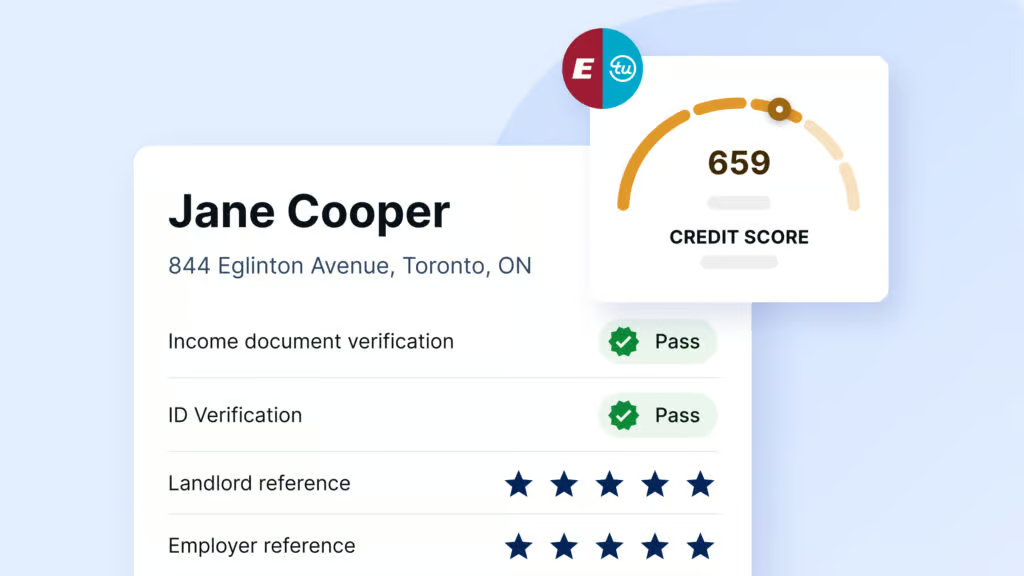
Before you put the terms of the tenancy in writing, make sure you're comfortable with the person you're renting to. A thorough tenant screening process helps you verify the information an applicant has provided and assess whether they're likely to meet the financial and other responsibilities that come with the tenancy.
Screening should cover:
- Identity. Check government-issued ID and, where appropriate, use fraud-detection tools to confirm the applicant is who they say they are.
- Income and employment. Review pay stubs, employment letters or bank statements to verify the applicant's income and employment stability.
- Rental history. Previous landlord references can give you a better understanding of how the applicant has handled past tenancies.
- Credit history. A credit report can show how the applicant has handled loans, credit cards and other financial obligations.
- Background information. Where legally available, public records such as past evictions or criminal convictions may reveal relevant information that isn't captured in the rental application.
You can run these checks yourself or use a tenant screening service. SingleKey's Tenant Screening brings credit, income, identity and other screening information into one report, so you can review the applicant before you commit to the tenancy.
What legal requirements apply to Alberta residential lease agreements?
The Residential Tenancies Act sets the basic rights and responsibilities that apply to most Alberta landlords and tenants, while your lease adds the terms and property-specific rules for your particular tenancy. You can customize those details as long as they follow the RTA; a clause that conflicts with the Act is void even if the tenant has signed it. Within that legal framework, Alberta also gives landlords flexibility in how the agreement is created: it doesn't have to be in writing, and most residential landlords aren't required to use a standard government form.
Does an Alberta lease have to be in writing?
No. Alberta allows residential tenancy agreements to be written, verbal or implied by the way you and your tenant act, such as when a tenant pays rent and you accept it without a formal agreement. The Government of Alberta still recommends a written agreement because it gives both parties a clearer record if a question or disagreement comes up.
If you and your tenant disagree six months into the tenancy about who was supposed to pay for water, for example, a written lease lets you check what you agreed to instead of trying to reconstruct an earlier conversation from memory. The agreement should clearly document:
- how much rent is due and when
- who pays each utility
- when the tenancy starts and, if applicable, ends
- who is responsible for maintenance
- whether pets are allowed
- who can live in the unit
- other rules you've agreed to
Is there a standard Alberta lease agreement form?
No. Alberta doesn't require most residential landlords to use a standard government-issued lease agreement form, so you can draft your own agreement, start from a lease template or sample lease agreement, or use a digital tool to create one.
That applies to how you create the lease. The terms themselves still have to follow the RTA. If the Act gives a tenant a particular right, for example, you can't make them give it up simply by including a clause in the lease and having them sign it.
What other rules do you need to know?
Several RTA requirements apply before or shortly after the tenant moves in:
- The security deposit can't exceed one month's rent. The limit is based on the rent when the tenancy begins, so increasing the rent later doesn't allow you to increase the deposit.
- The security deposit must go into an interest-bearing trust account. Deposit it at a bank, treasury branch, credit union or trust company in Alberta within two banking days of receiving it. The province sets the minimum interest rate annually.
- The property must be ready for the tenant. It has to be available when the tenancy begins and meet the Alberta Minimum Housing and Health Standards at the start of and throughout the tenancy.
- You need to complete a move-in inspection. Do it within one week before or after the tenant takes possession, then give them a copy of the signed inspection report immediately afterward.
- If the agreement is written, give the tenant a signed copy. You have 21 days after the tenant signs and returns the agreement.
- Give the tenant your contact information. Within seven days after move-in, provide a written Notice of Landlord with your name and address for service, or post the notice somewhere clearly visible in the building's common area.
- You can't change the agreement on your own. Any change requires the tenant's consent.
Should your Alberta lease agreement be fixed-term, periodic or hybrid?
The type of tenancy you choose determines both how long the initial agreement lasts and what happens afterward. A fixed-term tenancy has a defined end date, while a periodic tenancy, such as a month-to-month tenancy, continues until it's properly ended. A hybrid combines the two by starting with a fixed term and then continuing periodically afterward.
Fixed-term tenancy
A tenancy running from September 1, 2026 to August 31, 2027 is a fixed-term tenancy, so both you and the tenant know from the beginning exactly how long the agreement will last. In Alberta, it generally ends automatically on the stated end date without either party having to give notice, which can be useful when you want more certainty around both the length of the tenancy and the rental income expected during that period.
That certainty can make planning easier if you expect to sell the property, complete a major renovation or use it for something else afterward. If the tenant leaves before the end of the term without a legal right or an agreement allowing them to do so, they may still be responsible for rent, but you must make a reasonable effort to find another tenant rather than leaving the unit vacant and charging the former tenant for the remaining months.
Periodic tenancy
A periodic tenancy has no predetermined end date, with month-to-month arrangements being the most common example. Instead of ending automatically after a set period, the tenancy continues until either you or the tenant properly ends it under Alberta's notice and termination rules.
That can be useful when there's no reason to commit to another fixed term. If the tenancy is working well, it can continue without requiring you and the tenant to negotiate and sign a new fixed-term agreement each year.
Hybrid tenancy
A hybrid tenancy gives you a defined initial term without requiring the tenancy to end once that period is over. A one-year agreement, for example, can be set up to become month-to-month when the fixed term ends, allowing the tenancy to continue if it's working well without requiring another one-year agreement.
Because a fixed-term and hybrid tenancy can look the same until the original end date approaches, the lease should make the transition clear from the beginning. Both parties should know whether the tenant is expected to move out when the fixed term ends or whether the tenancy will automatically continue on a periodic basis.
What should you include in an Alberta residential lease agreement?
A useful lease explains how the tenancy will work day to day, not just the property, rent and tenancy dates.
At minimum, a written Alberta lease should cover:
| Lease term | What to include |
|---|---|
| Agreement date | When you and the tenant enter into the agreement |
| Landlord and tenant information | Full legal names and addresses of the landlord and every tenant signing |
| Rental property | The full address or description of the rental premises |
| Tenancy term and renewal | Start date, whether it's fixed-term, periodic or hybrid, the end date if there is one, and whether or how the tenancy continues afterward |
| Rent | How much the tenant pays, when it's due, and where and how they pay it |
| Additional fees | Any fees beyond rent, what they're for, when they apply and how they're calculated |
| Security deposit | The amount collected, how interest is handled and any lawful deductions that may be made at the end of the tenancy |
| Maintenance and repairs | What you're responsible for and what the tenant is responsible for |
| Insurance | Any tenant insurance requirements |
| Utilities and amenities | Which utilities the tenant pays and what's included with the rental, such as parking, appliances, laundry or storage |
| Occupants and property rules | Who can live in the unit and any lawful rules for pets, guests, smoking, home-based businesses, subletting or assignment |
| Entry and privacy | How you'll give notice of entry and any access procedures |
| Move-out | Cleaning, key return, inspection expectations, allowable deductions and how the security deposit will be handled |
| Other terms | Any other lawful terms you and the tenant agree to |
| Signatures | Your signature and the signature of every tenant who is part of the agreement |
Be specific about the details
Many lease disputes come down to the landlord and tenant having different understandings of the same agreement, especially when broad wording leaves room for interpretation. If the tenant pays electricity and internet while you cover water and gas, for example, listing each utility gives both sides a much clearer record than simply writing "tenant pays utilities."
The same principle applies to responsibilities around the property. If the tenant is expected to mow the lawn, remove leaves and shovel the walkway, list those tasks rather than relying on a broad term like "yard maintenance." The lease doesn't need to anticipate every possible situation, but it should be specific wherever a general term could reasonably mean something different to you and the tenant.
That includes clearly addressing:
- which utilities the tenant pays
- snow removal and yard work
- who is allowed to live in the unit
- pets
- smoking
- guests
- parking
- storage
- home-based businesses
- subletting or assigning the tenancy and the process the tenant needs to follow
If you're renting out a condominium, the applicable condominium corporation bylaws become part of those practical expectations as well, so provide the bylaws to the tenant and clearly document their obligation to follow them during the tenancy.
Include the required RTA statement
Every written Alberta tenancy agreement must include the following statement in print larger than the rest of the agreement:
"The tenancy created by this agreement is governed by the Residential Tenancies Act and if there is a conflict between this agreement and the Act, the Act prevails."
The practical effect is that putting a term in the lease and having the tenant sign it doesn't make that term valid if it conflicts with the RTA. Alberta limits the security deposit to one month's rent, for example, so a signed clause requiring a two-month security deposit would still be invalid.
Check any property-specific terms you add against Alberta's tenancy rules before you use them.
How should you create your Alberta lease?
There are two ways to create an Alberta lease agreement: manually, by drafting your own or customizing an Alberta lease agreement template, or online with a digital lease tool like SingleKey eLease.
| Feature | Draft or template | eLease Free |
|---|---|---|
| Speed to complete | SlowerYou draft or adapt each section yourself. | FasterAnswer questions about your rental and eLease builds the agreement as you go. |
| Alberta requirements | Check them yourselfMake sure the required RTA statement and Alberta rules are covered. | Built inIncludes the required RTA statement and the Notice of Landlord. |
| Customizing terms | Done by handWrite and attach any additional terms yourself. | Built inChoose recommended clauses developed in consultation with RTDS, or add your own terms and documents. |
| Signing | On paperPrint, sign and get copies to everyone yourself. | ElectronicSend for e-signature and track who has signed. |
| Storage | Your own filesKeep paper or local copies organized yourself. | In your accountThe signed lease is stored in your SingleKey account. |
| Reusing a lease | Start overDraft a new agreement for each tenancy. | Start from a previous leaseUpdate only what's changed. |
| Cost | Free or paidDrafting is free. Template costs vary. | FreeNo charge to create, send or sign, and no credit card required. |
If you're drafting the lease yourself, the Government of Alberta's residential tenancy resources can help you understand the provincial requirements. A free Alberta lease agreement template or PDF gives you a prebuilt structure to start from, but you'll still need to adapt it to your rental, confirm it's current and appropriate for Alberta, and handle signing and storage yourself.
Create your Alberta lease online for free
Build your lease, add the terms you need and send it to your tenants for e-signature. Free to create, send and sign. No credit card required.
Create your leaseWhat do you need to do after the lease is signed?
Once the agreement is signed, there are still several steps to complete before or shortly after move-in.
- Give the tenant a signed copy of the lease. For a written agreement, you have 21 days after the tenant signs and returns it.
- Complete the move-in inspection. Do it within one week before or after the tenant takes possession, and give them a copy of the signed inspection report immediately afterward.
- Put the security deposit in trust. It must go into the required interest-bearing trust account within two banking days of receiving it and can't exceed one month's rent.
- Give the tenant your contact information. Within seven days after move-in, provide the required Notice of Landlord with your name and address for service, or post it somewhere clearly visible in the building's common area.
- Hand over the keys and other access devices. This may include fobs, garage remotes, mailbox keys and anything needed to access included amenities.
- Keep your records. Alberta landlords must keep inspection reports for at least three years after the tenancy ends, so store the signed lease, inspection reports and other tenancy documents together where you can find them if an issue comes up later.
The property also needs to be ready for possession on the first day of the tenancy and meet Alberta's housing and health requirements. A rental inspection before move-in gives you an opportunity to check the condition of the unit and confirm that the tenant can access the services and amenities included in the lease.
Even with careful screening and a well-documented tenancy, a lease can't guarantee that rent will be paid or that the property won't be damaged. SingleKey's Rent Guarantee provides additional financial protection for eligible tenancies if those problems arise.
Create your Alberta lease with confidence
A well-drafted lease gives you and your tenant a shared record of how the tenancy will work, including the rent, responsibilities and property rules you've agreed to.
You can draft the agreement yourself, adapt a current Alberta lease agreement template or use SingleKey eLease to create, sign and store your Alberta lease in one place.
Alberta lease agreement FAQs
Can a landlord increase rent during a lease in Alberta?
Not during a fixed-term tenancy.
For a periodic tenancy, you can increase the rent once at least 365 days have passed since the tenancy began or since the last increase, whichever is later. The amount of notice depends on the type of periodic tenancy: 12 full tenancy weeks for week-to-week, three full tenancy months for month-to-month, and 90 days for other periodic tenancies.
As long as those timing and notice requirements are followed, Alberta doesn't cap the amount of a rent increase under the province's rent-increase rules.
What is the penalty for breaking a lease in Alberta?
Alberta's RTA doesn't set a specific penalty. If a tenant leaves a fixed-term tenancy early without a legal right or your agreement, they may still be responsible for rent until the end of the term, but you must make a reasonable effort to re-rent the unit rather than leaving it vacant and charging the former tenant for the remaining months.
A lease-break fee in the agreement doesn't let you collect more than you would have received under the lease, and a fee that's larger than your actual losses may not be enforceable. In a periodic tenancy, such as month-to-month, the tenant can end the tenancy by giving proper notice.
Can landlords charge late fees for rent in Alberta?
Yes, along with other additional fees and charges, as long as the written lease identifies each fee, when it applies and how it's calculated. Late fees should also be reasonable and tied to the landlord's likely costs rather than set at a level that functions as a penalty.
Can a landlord enter a rental property without notice in Alberta?
No. The tenant's entry and privacy rights still apply, including the requirement to give at least 24 hours' written notice for most lawful entries. The notice must state the date, time and reason for entry.
That notice isn't required in a limited number of situations, including when the tenant agrees to the entry at the time, there's an emergency or the property appears to have been abandoned.
How long does a landlord have to return a security deposit in Alberta?
If you're not making any deductions, you must return the full security deposit, plus any interest owing, within 10 days after the tenant gives up possession.
If deductions are being made, what happens next depends on whether you already know the final amount. When you do, the same 10-day period applies to the remaining balance and statement of account. If you don't have the final numbers yet, you can provide an estimated statement and any undisputed amount within 10 days, then follow with the final statement and any remaining balance within 30 days.
Your inspection reports are particularly important here because failing to meet Alberta's inspection-report requirements can prevent you from deducting money from the security deposit for damage or cleaning.